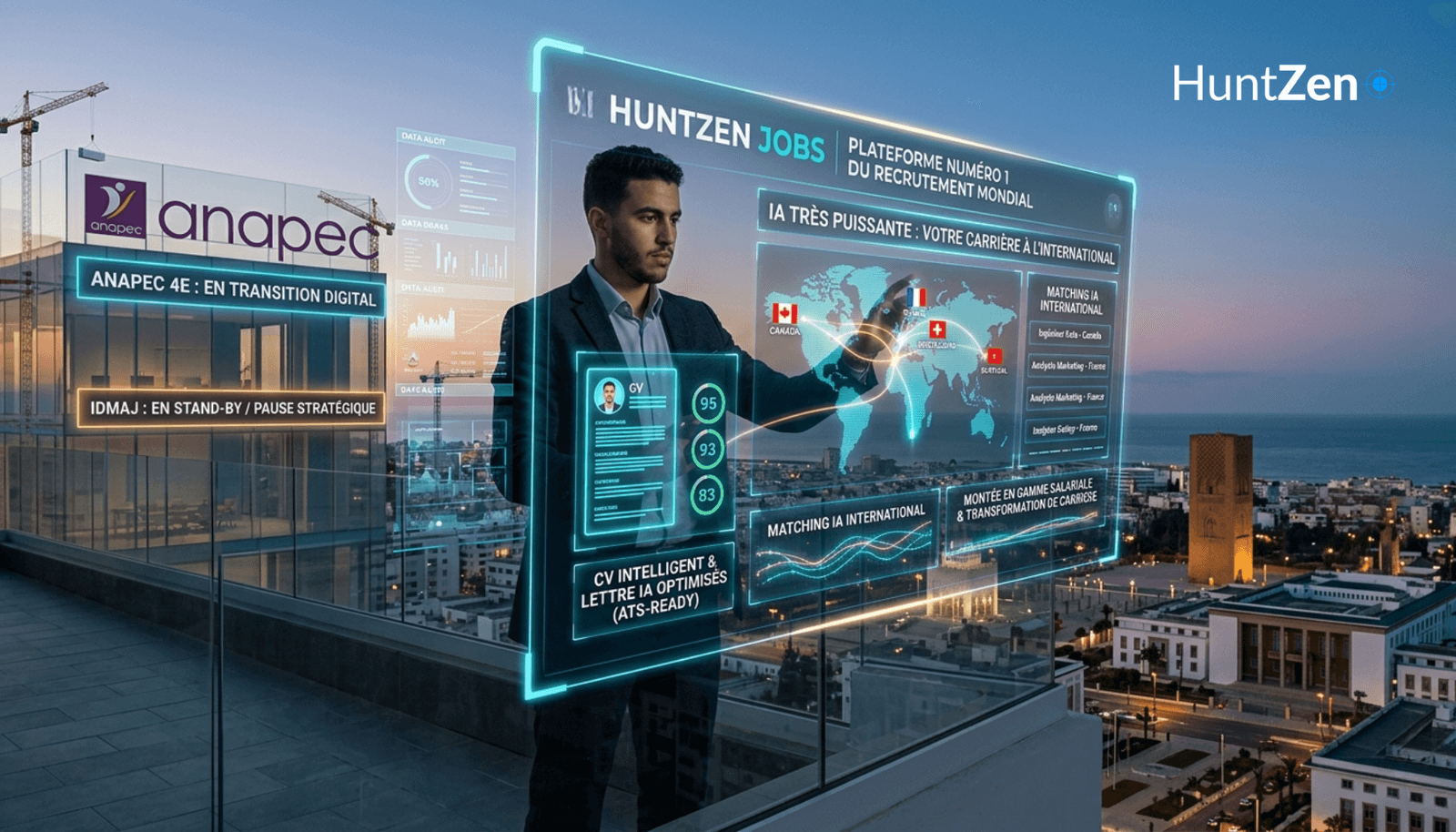
The start of the 2025 school year has placed tens of thousands of young Moroccan graduates faced with an uncomfortable question: are the public professional integration schemes on which they were counting still operational? The IDMAJ program, one of the historical pillars of the integration of first-time job seekers in Morocco, was going through a period of structural revision in 2025 which made it less accessible than in the past. At the same time, ANAPEC undertook a significant organizational transformation, redesigning its missions and methods of intervention. Between standby on one side and transition on the other, the 2025 laureates found themselves in a moment of institutional uncertainty which deserves to be analyzed honestly.
Understanding what is happening, identifying available alternatives and knowing where to turn has become a skill in its own right for young people seeking to enter a job market that does not wait for administrative readjustments. This article offers a clear reading of the situation, the measures still active and the integration strategies which operate outside of traditional programs.
IDMAJ: the emblematic program and its limits revealed
The IDMAJ program has been, since its creation, one of the integration mechanisms most used by young Moroccan graduates. Its principle is simple: it allows a first-time job seeker to be hired on a professional integration internship by a private company, with partial financing of the salary cost provided by the State, the stated objective being conversion to a permanent contract at the end of the internship period. Hundreds of thousands of young people have passed through this system over the last fifteen years.
But IDMAJ has also been the subject of recurring criticism. The conversion rate into real permanent contracts remained well below the stated objectives. Companies have been accused of using the program as a source of subsidized labor without any real intention of permanent integration. The maximum duration of IDMAJ contracts being limited, some employers chained trainees without ever hiring. These abuses have led the public authorities to review the terms of the program, introducing new eligibility criteria for companies and strengthening controls on the quality of integration.
In 2025, this revision resulted in a notable slowdown in the number of new IDMAJ agreements signed. Some ANAPEC agencies have temporarily suspended registrations pending new regulatory texts. Others have reduced the eligible sectors or strengthened the conditions placed on beneficiary companies. The concrete result for the 2025 winners is reduced availability of the program, without clearly defined official alternatives having been communicated with the same visibility.
ANAPEC in transformation: what is changing in missions and services
Since 2024, the National Agency for the Promotion of Employment and Skills has been undertaking an overhaul of its intervention methods. This transformation responds to several observations: local agencies lacked the means to offer truly personalized support; the relationship with companies was too one-sided, focused on providing candidates rather than understanding the needs of recruiters; the digital tools offered to job seekers were underused and poorly connected to market realities.
ANAPEC's new orientation places more emphasis on qualification and skills development than on simple supply-demand matching. Concretely, this means that employment advisors are trained to direct applicants towards short, certified training courses rather than limiting themselves to registration in application databases. Partnerships with training establishments — OFPPT, approved training centers, private organizations — are strengthened to create fluid bridges between job applications and skills development.
For the 2025 winners, this transition is manifested by longer waiting times in certain agencies, variable availability of advisors depending on the region, and sometimes insufficient communication on the new systems being deployed. The experience in the agencies of Casablanca, Rabat or Tangier can be very different from that experienced in Beni Mellal or Errachidia, where human and technical resources are less abundant.
Active devices that work in 2026
Despite the turbulence around IDMAJ and the transition of ANAPEC, several systems remain fully operational and accessible to the 2025 winners.
The Taehil and Taehil Vert programs, intended for retraining and strengthening skills, are active and funded. They allow unemployed graduates to follow additional training in areas under pressure, with training costs covered and sometimes monthly compensation for the duration of the course. These programs are particularly suited to graduates whose initial training is far removed from the immediate needs of the market.
Work-study contracts, introduced by law 51.25, represent a new path to integration that combines training and professional experience. Companies that welcome young people on work-study programs benefit from exemptions from social charges, which encourage them more to get involved than under the classic IDMAJ regime. For 2025 winners who have less than two years of professional experience, work-study training can be a real gateway to permanent employment.
Self-employment and entrepreneurship benefit from increased support via several counters. The Intelaka program for financing youth projects, regional incubators and seed funds set up in several regions of Morocco constitute a support ecosystem which has become more dense in recent years. For winners who have a viable project, these resources are more accessible than they were five years ago.
What to do concretely if you are a 2025 winner without a job
The first recommendation is not to wait passively for a public system to reopen or for a reform to materialize. The labor market does not pause during institutional transitions. Starting to apply actively, even in the absence of a specific integration program, is the most effective approach.
The second recommendation is to register with ANAPEC even if the service seems degraded. Registration remains the mandatory entry point for most employment support schemes, and having an active file means you will be informed of new schemes as they are rolled out. Delays are sometimes long, but registration costs nothing and does not close any doors.
The third recommendation is to diversify search channels. Online job offer platforms today represent a significant part of recruitment in Morocco, particularly in the modern sectors and companies with international capital. Platforms like Huntzen, aimed at the Moroccan and African market, allow you to position yourself on offers adapted to your profile while benefiting from visibility with recruiters who do not go through public systems.
The fourth recommendation is to invest in complementary skills without delay. Short online training courses, professional certifications recognized by employers, and a linguistic or technical upgrade can be completed in two to four months and significantly transform the attractiveness of a profile. In a context where public systems are less available, personal investment in training becomes a strong differentiator.
The role of professional networks in a context of weakened systems
When institutional channels are less fluid, informal and professional networks become even more important. A large part of the jobs filled in Morocco are by co-optation or recommendation, without ever going through a published offer. Graduates who have cultivated connections with professionals in their sector during their studies, who have participated in networking events or who are active in professional communities have privileged access to these unpublished opportunities.
Building this network requires time and proactivity, but it is precisely the type of investment that pays off the most in a market where formal mechanisms are insufficient. Alumni associations, recruiting events hosted by large companies, industry conferences and online communities are all spaces where useful connections can be made.
The institutional uncertainty of 2025 is temporary. Public systems are being reformed, strengthened and redeployed. But in the meantime, the winners who choose action over waiting, diversification over dependence on a single channel, and continued development over passivity will be those who will insert themselves most firmly into the Moroccan labor market.